
What Grant County Property Tax Records Show
Two Grant County offices produce these records. The PVA handles assessment, while the Sheriff handles collection, and each answers different questions.
| Field | What It Shows | Where |
|---|---|---|
| Roll owner and parcel | Dated assessment identity and key | Grant PVA qPublic |
| Assessed value | Annual fair-cash valuation context | Grant PVA |
| Exemption treatment | Adjustment that may reduce taxable value | Grant PVA |
| Tax bill and status | Amount and posted payment state for one year | Grant Sheriff / ProperlyTaxes |
| Municipal charge | A separate city layer where applicable | Relevant city tax office |
A tax bill proves neither a sale nor current title. Its owner label reflects a point in time, so note the assessment year, bill year, and retrieval date.
Grant PVA Assesses While the Sheriff Collects
For the assessment side, the Grant PVA qPublic application opens owner, address, parcel ID, alternate ID, sales, map, tax-bill, plat, restriction, and deed routes. Its notice ties what displays to the last certified tax roll. For payment, the Sheriff's property-tax page explains collection and routes to current and prior bills.
Ask the PVA about values. Ask the Sheriff about payments. The Sheriff accepts no partial payments. A payment made after delinquency may take time to post.
January 1 Sets the Grant Tax-Roll Owner
The tax-roll owner is fixed on January 1, per PVA guidance. The Sheriff keeps the bill in that owner's name all year. The Sheriff's office does not receive new deed transfers directly. A Grant County buyer can be the newest recorded grantee. The bill still carries the seller.
Track three dates separately: the bill year, the PVA roll date, and the newest deed recording date. The mismatch is usually lawful timing rather than a mistake. Never treat the bill name as proof of current title.
Understand Grant County Assessment Terms
Key tax-record concepts
- Fair cash value
- Kentucky's assessment standard, not a promise that the assessment equals the last sale.
- Assessed value
- The PVA's dated valuation for the roll.
- Taxable value
- The assessment after applicable exemption treatment.
- Tax lien
- A legal claim associated with unpaid taxes, distinct from an ordinary bill.
Kentucky requires real property to be assessed at 100 percent fair cash value. Grant PVA revalues annually and physically examines property at least once every four years. Because sale conditions, timing, appraisal methods, improvements, and exemptions all vary, the assessed value, taxable value, and recorded price can legitimately differ.
Look Up a Grant County Tax Bill
Locate the parcel in qPublic, then follow its tax-bill route or open the Grant ProperlyTaxes portal. Before reading any amount, check the year, parcel, description, and owner label.
- Resolve the address to a PVA parcel and copy its exact ID.
- Open the correct bill year rather than the first result.
- Compare assessment, exemptions, charges, penalties or discounts, and status.
- Check earlier years separately and save the access date.
- Assessment
- The PVA's dated valuation input.
- Rate or levy
- A charge applied by a taxing authority.
- Exemption
- Qualifying treatment that may reduce taxable value.
- Status
- The collector's posting for the selected bill year.
Current bills route online, and the county website posts the previous five years, according to the Sheriff. If a recent payment has not posted, confirm any time-sensitive payoff directly with the office.
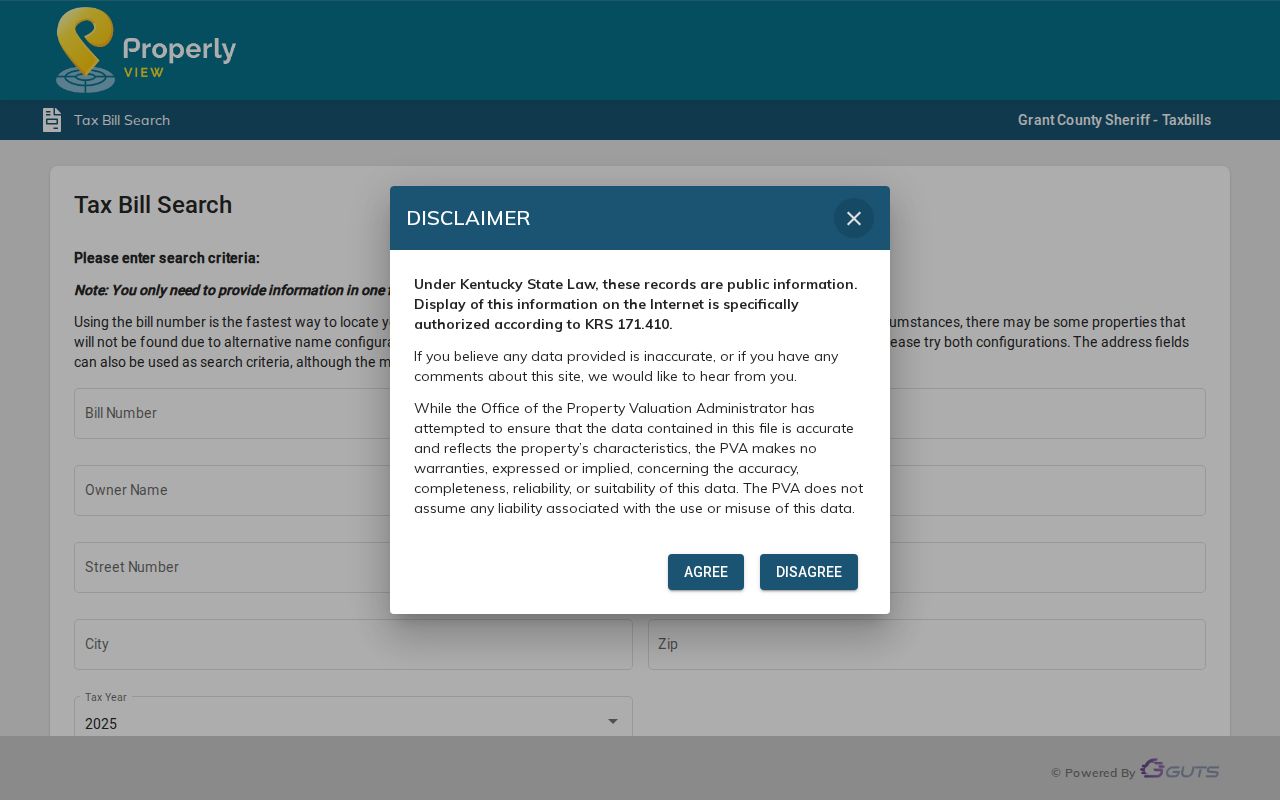
The image shows the official viewing and payment destination for Grant County bills.
Grant Homestead and Disability Exemptions
Kentucky's homestead and disability exemption attaches to the owner. It is applied for through the PVA. The current form is 62A350, with an amount of $49,100 for 2025 through 2026. Both eligibility and the amount change over time. So get the live form and decision from Grant PVA. An exemption lowers the taxable assessment; it never rewrites the deed or sets market value.
Kentucky's Calendar Governs Grant Assessment Review
The Kentucky property-tax calendar sets the rhythm. Listing runs January 1 through March 1, and the roll opens for public inspection for 13 days starting the first Monday in May. PVA conferences happen during that inspection window. A taxpayer generally conferences before appealing to the county board, which begins work 25 to 35 days after inspection starts. Verify the exact dates locally each year.
Appeal a Grant County Assessment with Evidence
Start with the PVA conference during the inspection period. Bring the parcel card, photographs, measurements, repair facts, arm's-length comparable sales, an appraisal if you have one, and proof of any wrong property characteristic. Argue the valuation as of the assessment date, not the bill total.
Protect the appeal window. Kentucky's May inspection and conference sequence precedes the county-board stage; confirm the exact current dates and filing method with Grant PVA.
Keep copies of everything. The conference request, exhibits, board filing, notices, and proof of delivery all matter. Later appeal routes do not excuse a missed local step.
Statewide rules also shape what Grant County evidence should address. Kentucky revalues real property annually and physically inspects it at least once every four years. Assessors may use sales-comparison, cost, or income approaches. Land and improvements are rolled into the total. Fair cash value does not promise the roll will match the last recorded sale. A strong conference submission names the incorrect characteristic or valuation input. It also ties each comparable or photograph to January 1.
Distinguish Grant Delinquency and Tax-Sale Records
Delinquency and tax-sale records sit in different hands in Grant County. The Sheriff collects current bills. The County Clerk has duties tied to delinquent tax-bill sales. No complete Grant sale-list or redemption field inventory is published online. Ask the Clerk for the specific year's certificate, purchaser, assignment, and redemption records. Do not infer a tax sale from an unpaid bill screen. A bill, a lien, a certificate, a court action, and a deed are distinct documents. None substitutes for another.
The Sheriff's online scope covers the current year plus five prior years. Full payment only; no partials. Card payments carry a fee. A bill paid after delinquency may lag on the display. Keep the receipt and confirm status with the collecting office. When you need older years, request the named record rather than reading the portal's boundary as a retention rule.
Crittenden Has a Separate 2026 City Tax Layer
Crittenden sets its own 2026 city levies. Real-estate tax runs .167 per $100 of assessed value. Tangible property carries .177 per $100. The ambulance levy adds another .100 per $100. Bills mail October 15. A two-percent discount runs through November 15, and the base amount comes due December 31. None of these are Grant PVA figures. They do not apply to Dry Ridge, Williamstown, or unincorporated parcels.
Williamstown runs its own municipal property-search and tax route. When land sits inside a city, date and label that city's bill separately from the Grant County assessment and the Sheriff's collection record.
Annexation can move a boundary. A postal city never proves taxing jurisdiction by itself. Compare the parcel's city context with the effective ordinance or zoning source before attaching a city charge to it.
Keep city and county figures on separate dated lines. The PVA supplies the assessment base, the Sheriff shows county collection status, and a municipality may publish its own bill or rate schedule. Crittenden's stated discount and due dates describe that city's 2026 process alone. They do not alter the Kentucky assessment appeal calendar, and a ZIP 41030 address does not automatically fall inside Crittenden. Confirm municipal jurisdiction from the boundary record before applying a city rate.
The January 1 owner rule travels with every comparison. A deed recorded after that date can name a new grantee while the PVA roll and the Sheriff's bill still carry the earlier owner for that tax year. The PVA attempts new-owner mailing from recorded-deed information. A changed mailing destination is not a revised tax-roll owner. Record the deed date, roll year, bill year, and payment date separately.
Missing delivery does not erase the duty to check the bill. Grant PVA guidance sends an owner who receives nothing to the Sheriff. Match the parcel ID and situs against the bill rather than relying on the mailing name alone, then keep any corrected-address correspondence with the dated tax record.
Date Every Grant County Value Report
Grant County's qPublic portal offers an assessed-value report for each parcel. The detailed parcel-value data sits behind authentication. So treat the public page as a route rather than a value. A complete report shows the parcel ID and the certified-roll year. It also shows land value, improvement value, and the total assessment. It should also carry any value history and recorded-sale display exactly as labeled. Never fill a missing field from another county's card. The Grant assessed-value report surface is the official place to confirm those live fields.
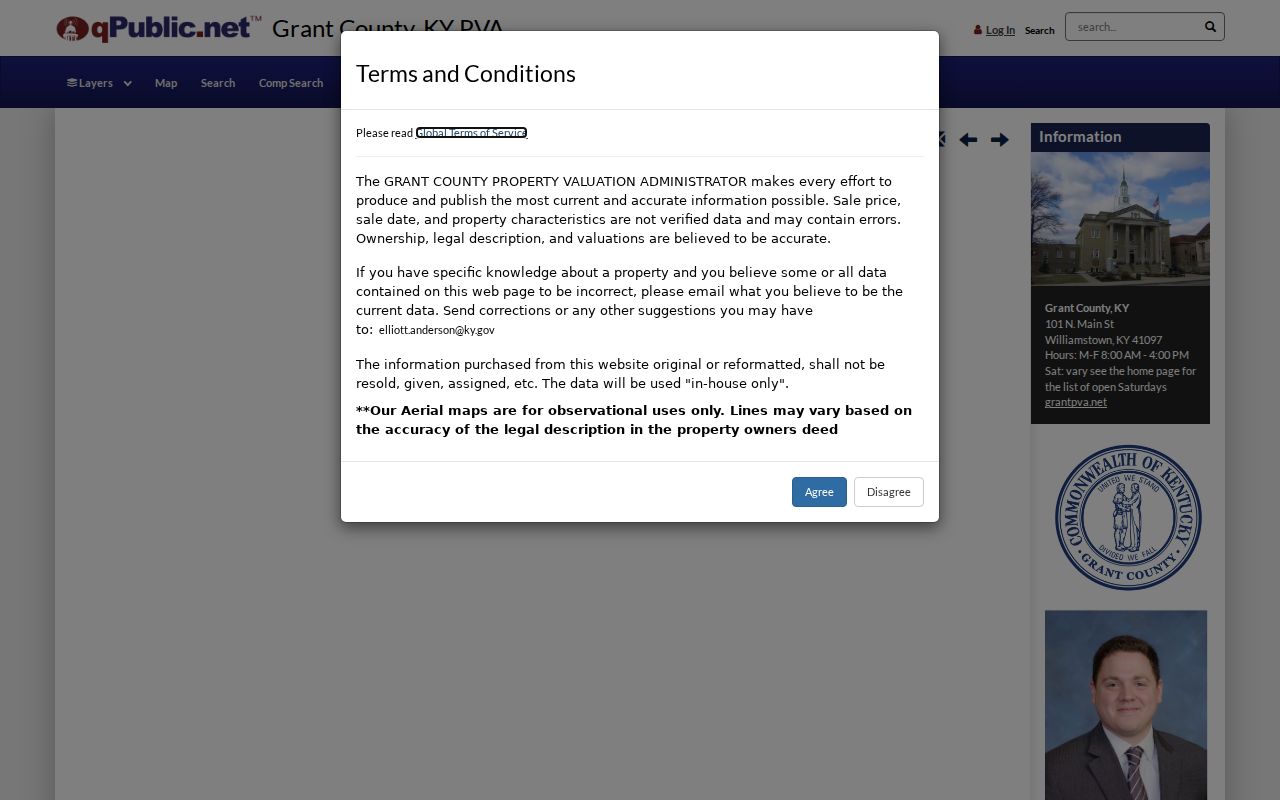
The report surface documents the route, not a certified value. Pair any parcel detail with its source date. That keeps the certified roll distinct from changes pending before the next roll.
Request Unpublished Grant Tax Records Precisely
Address the request to the office that keeps the record. Kentucky Open Records Act section KRS 61.872 permits a signed, precisely described request. Deliver it by hand, mail, fax, or email. Include the parcel ID, property address, tax year, record type, and a narrow date span. Be specific. A named assessment worksheet, conference record, delinquent-sale certificate, or redemption document serves better. It beats a request for every file tied to an address. Save the response with the bill and assessment papers.
A missing online item is not proof a record never existed. Keep it factual. The office either holds the record or it does not. Requests under KRS 61.872 should identify an existing record. Do not ask an office to build a new valuation analysis. State the format you want. Ask to be contacted about copying or postage cost. If part of the file is withheld, request any reasonably segregable nonexempt portion. A record in storage or active use should draw a response giving an availability date. Or it should explain why more time is required.