
Read Grant County's Current Owner Record
The Grant PVA qPublic application is the natural starting point for a Grant County property search. The assessment roll carries the owner of record, the situs and mailing addresses, the parcel number, alternate IDs, sales history, map and plat views, restrictions, tax bills, and deed references. Field labels on the result card can change as the vendor updates the interface, so read the owner name directly from the record rather than assuming a fixed label.
| Owner entry | Exact tax-roll name and certified-roll year |
|---|---|
| Mailing address | Notice destination, which may be outside the county |
| Situs address | Physical location of the parcel |
| Last sale | A dated transfer clue, not title proof |
| Deed reference | Book/page or instrument that supports the transfer |
| Parcel ID | Stable key used to match the same tract |
The owner of record is not necessarily an occupant, and the mailing field is not the situs. Keep the values separate and preserve the source date.
Read the card as a dated assessment record. Kentucky's annual process values real property as of January 1, and the PVA works from the certified roll while changes can be developing for the next roll. A current owner result should therefore include the tax year and the day it was checked. If qPublic shows a sale or deed link, use it as a bridge to the recorded instrument, not as a substitute for that instrument. Copy the parcel ID before leaving the card because names, postal addresses, and street formatting can vary across systems while the parcel key keeps the comparison tied to the same tract.
January 1 Dates the Grant County Owner Roll
Ownership for tax purposes is fixed on January 1. That is the rule under the PVA's official guidance. A later buyer may still receive PVA mail drawn from deed data. Yet the year's tax name can remain the January 1 owner. The Sheriff does not access new deed transfers directly.
Recent-sale gap. A tax bill can name the former owner after a newer deed has placed the property in another grantee.
Note: Record the roll year, the deed recording date, and the date you checked next to any Grant County current owner answer.
Four Grant County Fields Must Stay Separate
A sound current owner note keeps four fields apart. The roll owner, mailing address, situs address, and latest deed grantee each answer a different question. The mailing address routes notices. The situs locates the land. The deed names the transfer recipient.
Current-owner terms
- Owner of record
- The name carried on the dated assessment roll.
- Certified roll
- The assessment dataset used for the tax cycle.
- Situs
- The physical property location.
- Recording lag
- Delay before another system reflects a transfer.
Entity names and trusts make the separation matter even more. A registered agent or trustee is not automatically the beneficial owner of the parcel.
Confirm Grant County's Current Owner Now
Move from the assessment record to the newest recorded deed without walking the whole historic chain.
- Search Grant qPublic by address and record the parcel ID, owner entry, situs, mailing address, and roll date.
- Open eCCLIX and find the newest deed for the same land.
- Compare its grantee, recording date, deed reference, and legal description with the roll.
- For an LLC, confirm the exact legal name through the Kentucky business search.
- Owner of record
- The party named on the roll.
- Vesting
- How the deed places title in a person, trust, or entity.
- Registered agent
- An entity contact, not proof of personal ownership.
The newest deed should describe the same land. Compare the parcel reference where shown. Check the legal description, prior book and page citations, and the grantor and grantee names. A name match alone can mislead. Relatives often share a name, or an entity owns several tracts. If the latest image falls before eCCLIX coverage, the Grant County Clerk directs researchers to call for earlier material. Deed images begin in June 1986. Older books may require clerk help, KDLA microfilm, or a FamilySearch catalog route. That archive step confirms the underlying transfer. It does not turn a present-owner check into a full historic chain.
Grant qPublic Capture Limits Matter
The qPublic search surface is the documented entry point. The public view includes no authenticated parcel card. A tax-bill image cannot substitute for the current owner card. No exact field label can be claimed from it. The live, dated parcel result is what supplies the owner answer. View the official qPublic search source shown below.
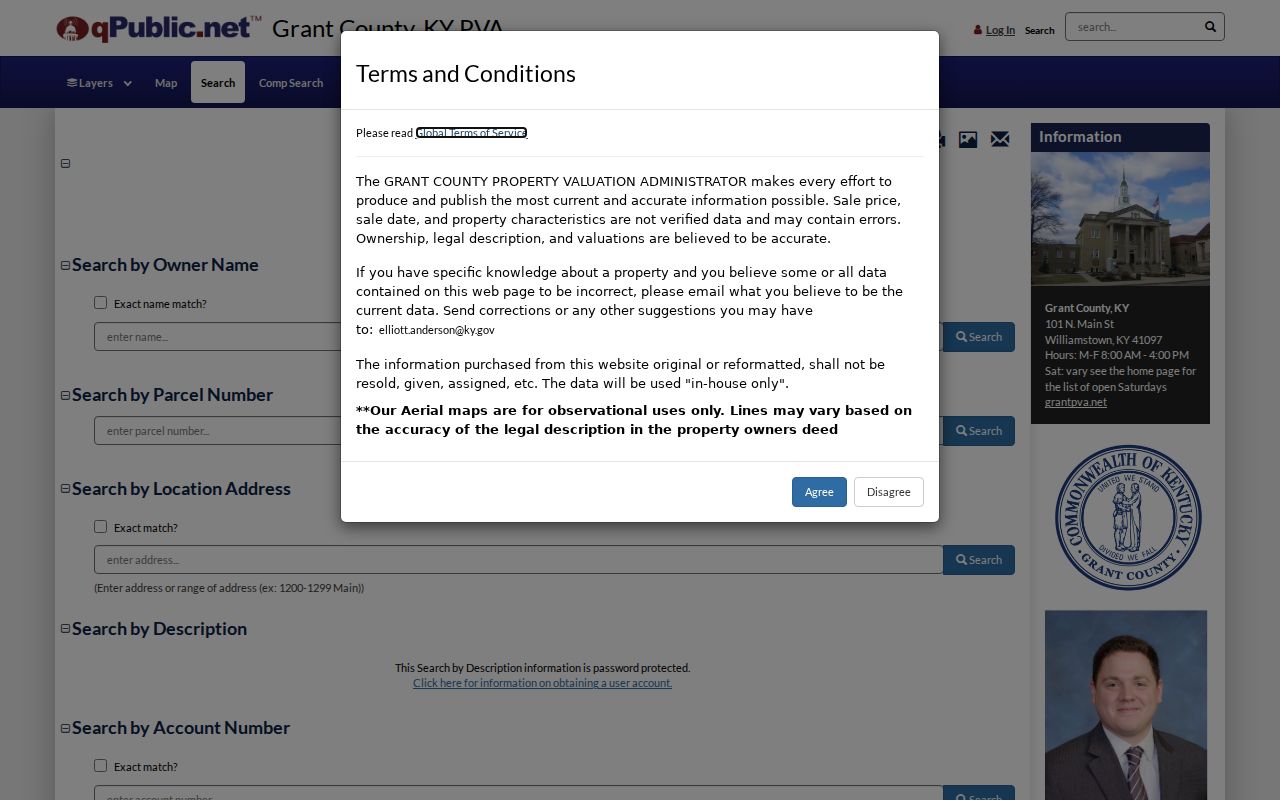
The entry point is documented; a live dated parcel result supplies the owner answer.
Entity and Trust Names on Grant County Records
Copy an LLC, estate, or trust name exactly as the roll and deed display it. Kentucky's business database can validate an LLC and its registered agent. Probate material may explain an estate transfer. Neither replaces the recorded property instrument.
The eCCLIX personal account is free but limited to five searches per day. Prepare the entity variants and deed date before signing in. That way the current owner check does not burn the daily allowance.
Note: Match the parcel description as well as the entity name. Similar names can point to unrelated land.
Kentucky Safe at Home and Property Records
Safe at Home provides substitute-address protection and mail forwarding for eligible participants. Official materials state a real-estate-holdings exception. So an unusual mailing field does not mean the Grant County parcel record has vanished.
Use only the public record needed for the property purpose. Do not infer who lives at the situs from an assessment mailing address.
Know the Limits of a Grant County Current Owner
The tax roll exists to administer assessments. It does not warrant title or confirm who occupies a property. When timing matters, compare the roll against the latest recorded deed. Keep both dates in your file.
A tax-bill account is another dated source, but it answers a collection question. The Grant County Sheriff ties each bill to the January 1 owner. The office does not receive every new deed transfer directly. Williamstown and Crittenden may keep municipal tax accounts on separate schedules. None of those accounts overrides the most recent valid recorded conveyance. When names conflict, keep a short source log rather than picking one silently. Record the qPublic roll year, the county bill year, any municipal account year, and the deed recording date. Also record the exact legal description used to match the tract.
Some ownership questions need more than an online comparison. A quiet-title judgment can change what an index entry means. So can a commissioner sale, probate distribution, or tax-sale deed. CourtNet may locate a case. Kentucky court guidance places the actual file with the clerk of the court that heard it. Request the judgment or transfer document, then find the matching recorded instrument. For a routine purchase or an estate question, a title professional can review matters beyond the public index. That review can cover unreleased interests or recording defects an assessment card was never built to resolve.
Lawful use. Use owner data for deed review, boundary communication, estate work, or purchase diligence. Never use it to stalk, harass, intimidate, or harm anyone.
Use the Grant County owner-finding method for the broader workflow. The previous owners record trail covers the history side.
Corrections follow custody. A wrong situs, building fact, or assessment entry goes to the Grant County PVA with the parcel key and supporting material. A misspelled party or questionable deed reference belongs with the Grant County Clerk. A payment-status issue belongs with the Sheriff. Ask each office what evidence and procedure it requires. Do not ask one custodian to change another office's record. That keeps correction of public data separate from disputing legal title. It also yields a cleaner current owner finding: one parcel, one dated roll entry, one latest recorded transfer. Add a written note for any mismatch that remains.